A commercial roof replacement on a school or public building starts with one question: when does the building have to be back in use? For a school, that date is the first day of classes. For a fire station, the answer is that it never stops being in use. Set that date first, then plan materials, phasing, trade coordination and documentation backward from it. The roof is built to the calendar as much as it is built to the spec.
I’m Andrew Ubben, owner of Blue Peaks Roofing. This year our crews replaced the roof on a PK-12 school campus in one summer and re-roofed four fire stations and a training facility while every one of them stayed in service. Here is what we learned about planning a public roof around a building’s calendar, and what facilities managers, districts and boards should ask before the 2027 budget meeting.
Why the summer window drives school roof replacement
For a school, summer is the work window. Between the last day of school and the first day of the next year, everything has to fit: tear-off, new roof systems, rooftop mechanical work, gutters, inspections and closeout.
That changes how the project gets planned. A school roof replacement can’t slide two weeks into September because a material order came in late or a trade wasn’t lined up. That’s why the planning happens months before the work does:
- Lock the dates early. Know the last day of school, the first day back, and any summer programs that use the building.
- Order materials with the calendar in mind. Metal panels, membrane, insulation and trim need to be on site when the crew is ready, not after.
- Line up every trade that touches the roof. Mechanical, electrical and gutter work has to be sequenced around the roofing, not added on at the end.
- Plan staging and site controls. Where material gets offloaded, where the crane sets up, how the work area is fenced and how debris is handled on a campus.
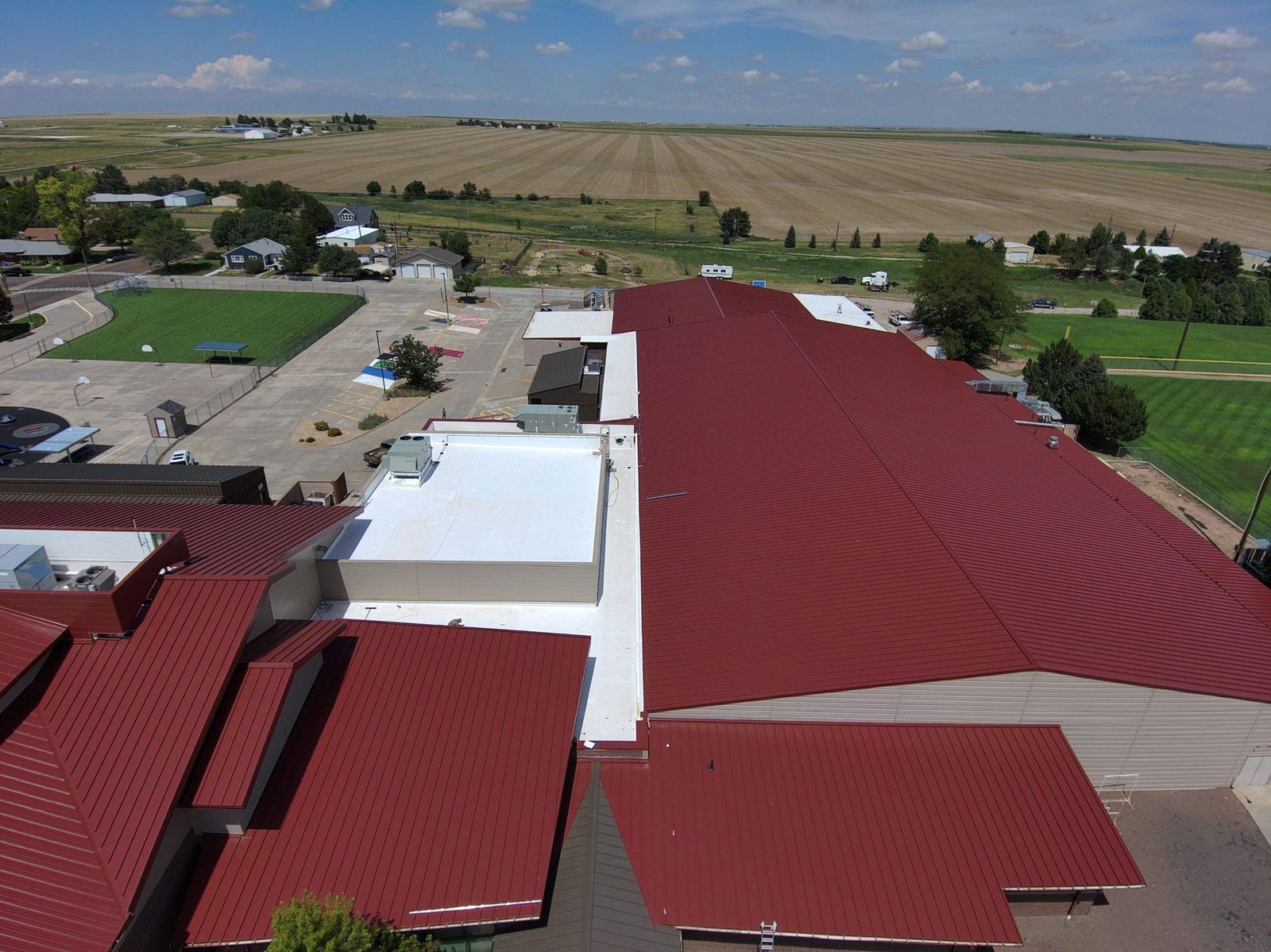
On the Akron School District R-1 campus, our crews started in late May and finished in mid-August 2026. That was close to 988 squares of new roof across two systems, and staff and students came back to a finished roof for the 2026-27 school year. You can see the full project on our
Akron school campus re-roof page.
When two roof systems meet: plan the transition before tear-off
Many school and public buildings have more than one roof system. A pitched section may be metal or shingles, and a low-slope section may be a membrane such as TPO. Each system handles water differently. Metal sheds water fast. A membrane on a low-slope roof is built to keep standing water out. The place where the two meet is where problems show up if nobody planned for it.
On Akron, that meant 828 squares of Sheffield Metal 22-gauge standing seam tied into a separate 159.59-square TPO system with cover board and insulation. The transitions between the two systems were detailed and flashed as part of the roofing scope.
Questions worth asking any roofer bidding a building with mixed systems:
- Where exactly do the roof systems meet, and how will each transition be detailed?
- Who is responsible for the rooftop equipment, curbs and screens that sit on or near those transitions?
- What gets removed and reset, such as snow retention, gutters or rooftop HVAC equipment, and which trade does it?
On Akron, the rooftop HVAC equipment was detached and reset by a mechanical contractor so the new panels could be seamed underneath, and new snow guards were installed. Those items belong in the scope from day one. If you are weighing membrane options for a low-slope section, our post on
TPO vs EPDM for Colorado buildings walks through the differences.
Phasing a public building roof replacement so the building stays open
Not every public building gets a summer off. Fire stations, for example, have to stay ready to respond every hour of every day. For those buildings, the plan isn’t about a window. It’s about phasing.
For the South Adams County Fire Protection District, Blue Peaks replaced roofs on Fire Stations 25, 26, 27 and 28 and the district’s Indoor Training and Wellness Facility, known as The Pound. That was about 715 squares across standing seam metal, PBR metal and impact-resistant shingles, built in two phases from June 2025 to July 2026. Every facility stayed in service.
What makes phasing work on an occupied public building:
- Decide the order of buildings with the owner. Which ones are in the worst shape, and which ones can tolerate work at what times?
- Protect operations at every site. On a fire station, scheduling, access and debris control have to protect apparatus readiness. Bays and drive lanes stay clear.
- Plan the largest roof on its own. The Pound was the largest roof in the program, about 356 squares of new 26-gauge PBR metal with new insulation.
- Match the system to each building. One district doesn’t mean one roof system. Each station got the materials and crew that fit its roof.
Phasing also spreads the work across budget years, which can help a board fund the project. Read more on the
South Adams County fire stations re-roof page.
Document every day of the job
A school district or public agency answers to a board, and often to the public. Owners shouldn’t have to take the roofer’s word for what happened up there. They should be able to see it.
On Akron, our crews documented the work from tear-off to closeout with more than 7,000 CompanyCam photos, so the district had a clear record of every phase. Good documentation gives facilities staff something to show the board, makes punch-list items easy to find and close, and leaves a record for warranty registration and future maintenance.
Ask any contractor bidding your project:
- How will we see the work as it happens?
- What do we get at closeout: photos, inspection results, warranty registrations?
- Who is our point of contact during the job?
Three questions to ask before your 2027 commercial roof replacement
If your school, district, or agency has a roof on the 2027 list, bring these three questions to your roofer before the budget meeting:
- When does the building have to be back in use? That date sets the schedule, the material orders and the crew plan.
- Where do the roof systems meet? Transitions and rooftop equipment should be detailed and scoped before tear-off.
- How will we see the work every day? Ask for photo documentation and a clear closeout package.
Start early. The summer window for a school roof replacement is short, and the planning for it belongs in the fall and winter before. Meeting with a roofer now gives you time to inspect the roofs, write a scope your board can review and get a price on the calendar before the budget is set.
Talk to Blue Peaks about your public or commercial roof
Blue Peaks Roofing is based in Littleton and works on commercial and public buildings across Colorado, from school campuses on the eastern plains to fire stations in the metro area. We’ll assess the roofs, photograph what we find and give you a written proposal your board can review.
See our
commercial roofing services and more
commercial roofing projects, or call us at
(303) 808-0687 to talk through your building’s calendar.