
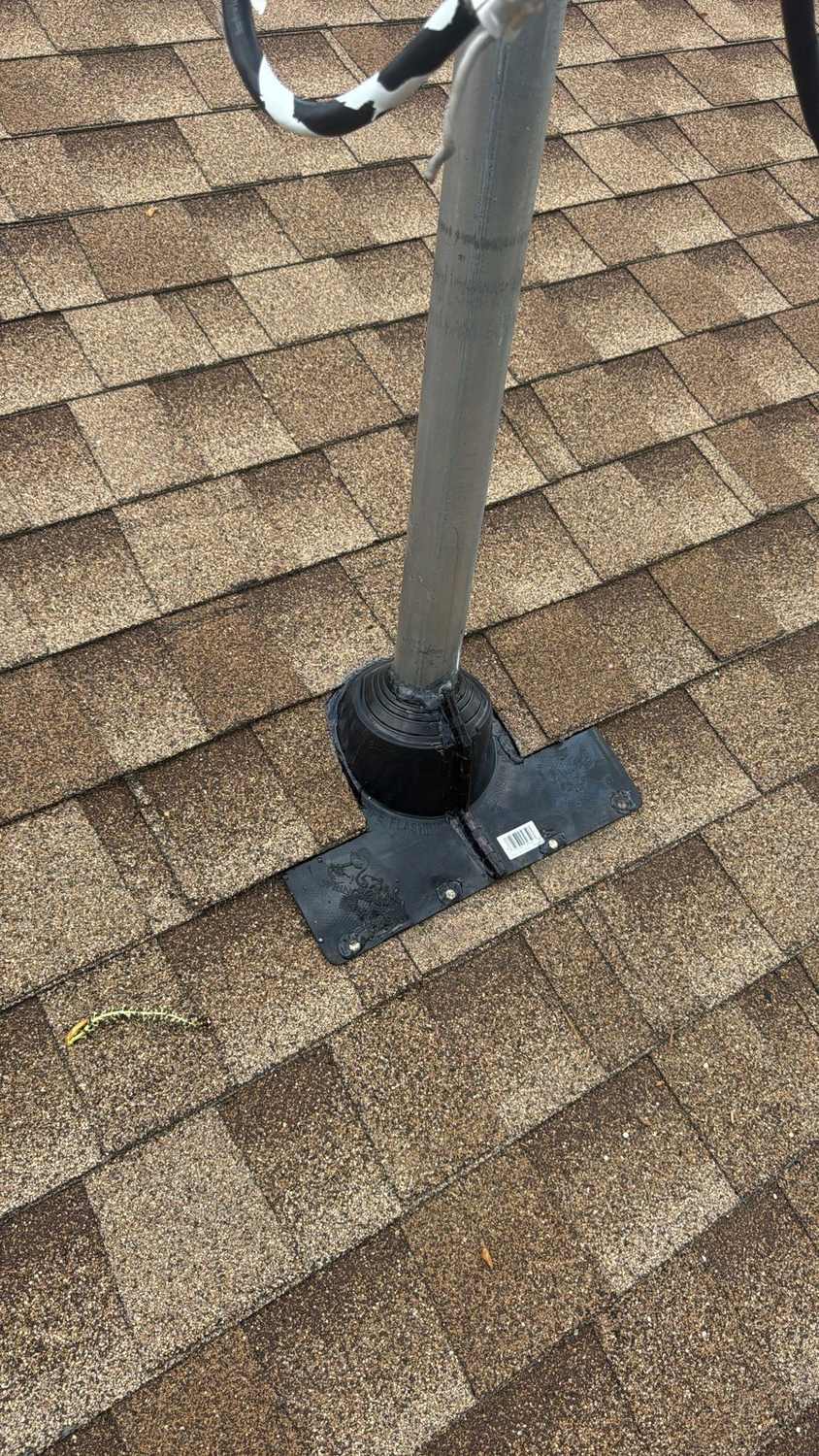
If your roof starts leaking, protect people and belongings first, catch and contain the water inside, write down and photograph what you see, and call a roofer to find the real source before anyone patches it. Don’t climb onto a wet or icy roof yourself. Most leaks can be fixed without replacing the whole roof, but only after someone finds where the water is actually getting in. That’s what our roof repair visits are built around: we find the cause, photograph it and give you a straight answer.
Here’s how we walk homeowners through it when they call us with water coming through the ceiling.
Step 1: Make the inside safe
Water and a ceiling don’t mix for long, so start with the inside of the house.
- Keep people and pets out from under the wet spot. A ceiling that’s sagging or bulging is holding water. Keep everyone out of that area until it’s dealt with.
- Keep water away from electricity. If water is dripping near a light fixture, outlet or ceiling fan, don’t touch it. If you can reach your breaker panel safely and know which circuit it is, shut that circuit off. Don’t walk through standing water to get to the panel. If you can’t reach it dry, leave it and call an electrician.
- Move what you can. Pull furniture, rugs, electronics and boxes away from the drip.
- Catch the water. Buckets, towels and a tarp or plastic sheet on the floor will save your flooring and drywall a lot of grief.
None of this fixes the roof. It just keeps a roof problem from turning into a bigger inside problem while you get help.
Step 2: Write down what you’re seeing
Before you mop it all up, take a few minutes to note what’s happening. It helps whoever comes out to find the source faster.
- Take photos and a short video of the drip, the stain and any sagging.
- Note when it started and what the weather was doing: heavy rain, wind-driven rain, melting snow, or a sunny day after a snowstorm.
- If you can get into the attic safely, look for wet insulation, dark stains on the roof boards or daylight coming through. Step only on the joists or attic boards, never on the drywall between them.
- Check outside from the ground. Missing, cracked or lifted shingles, flashing pulling away around a chimney or vent, or gutters overflowing can all point toward the problem.
The timing detail matters more than people think. A leak that only shows up during wind-driven rain often points somewhere different than one that shows up when snow is melting off the roof.
Step 3: Stay off the roof
We get it. You want to get up there and see what’s going on. Please don’t. A roof that’s wet, frosty or icy is dangerous even for people who walk roofs every day, and we use fall protection for a reason. Stepping on the wrong spot can also crack shingles or make an existing problem worse.
Viewing from the ground, from a window, or through binoculars is fine. Leave the climbing to a roofer.
Step 4: Call a roofer to find the source, not just the drip
Here’s the part that trips a lot of people up: where the water shows up inside is often not where it’s getting in. Water can travel along roof boards, rafters and underlayment before it drips through your ceiling. A stain in the middle of the living room ceiling might come from flashing around a vent several feet away.
That’s why a good repair starts with diagnosis. When we come out for a leak, we:
- Inspect the roof section by section and take photos of what we find, including the spots you can’t see yourself.
- Look at the usual suspects: flashing around chimneys, vents and skylights, roof-to-wall joints, damaged or missing shingles, and sealant that has dried out and cracked.
- Tell you honestly whether a repair is enough or whether the roof is at the point where repairs stop making sense.
- Give you a written scope and price before any work starts.
If you’re stuck between those two options, our post on roof repair vs. replacement walks through how to think about it.
What usually causes roof leaks in Colorado?
Every roof is different, but these are the problems we see most often on Front Range homes:
- Flashing and seals. The metal flashing around chimneys, vents and walls often wears out before the shingles do, and caulking and sealants dry out and crack in our sun.
- Damaged or missing shingles. Wind can lift shingles and break their seal, and age makes them crack and curl.
- Penetrations. Every pipe, vent and skylight is a hole in the roof that has to be sealed right.
- Ice dams. In winter, snow melts on the warmer part of the roof, runs down and refreezes at the colder eaves. The water backs up under the shingles and can show up as a stain near your exterior walls. Don’t chip at ice dams or climb a ladder onto icy eaves to clear them.
- Storm damage. Hail can bruise and crack shingles, and the damage isn’t always obvious from the ground. If your leak showed up after a hailstorm, our hail damage inspection page explains how we look at that.
Can a roof leak wait until spring?
We’d rather you didn’t wait. A small leak keeps soaking the roof boards, insulation and drywall every time it rains or the snow melts, and wet materials can lead to rot and mold over time. What starts as a quick repair can turn into replacing decking, insulation and drywall if it sits for months.
The good news is that a lot of repair work can still be done in cooler weather. Shingle sealing and some materials do depend on temperature, so we’ll tell you what makes sense for your roof and the forecast. Sometimes the right move is a temporary fix now and a permanent repair when the weather allows. We’ll be upfront about which one you’re getting.
What a good roof repair looks like
Whoever you hire, here’s what you should expect:
- A clear diagnosis with photos. You should see the problem, not just hear about it.
- A written scope and price before work starts.
- Photos of the repair while it’s underway and when it’s finished, so you know what was done on a part of the house you can’t get to.
- A check after the repair. We check our repairs from the attic and the outside, clean up, and walk you through what we did.
- Straight answers on warranty. On our residential roofs, our 5-year workmanship warranty covers qualifying installation-related defects. Repairs are handled case by case, and your contract spells out what’s covered before we start.
How Blue Peaks handles leak calls
We’ve worked out of our Littleton office since 2019, and we hold GAF Master Elite and TAMKO Pro Platinum credentials. Every job, repairs included, gets a dedicated project manager and photo documentation. Emergency repairs are available during business hours, and non-emergency inspections are typically scheduled within 24 to 48 hours.
Most roof problems are fixable without a full replacement. Our job is to find out which kind you have and tell you the truth about it.
Seeing water stains or a drip? Call us at (303) 808-0687 or schedule a free roof inspection. We’ll find the source, show you photos, and give you a straight answer.